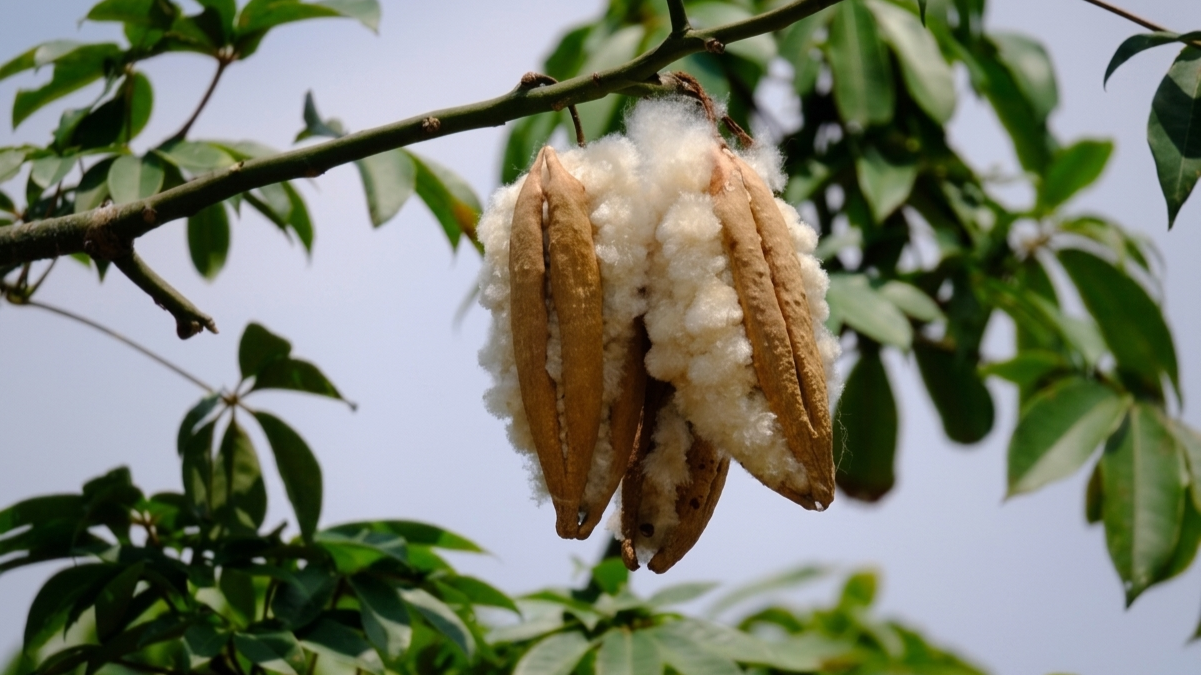
The flocking fiber the saddle industry hasn't caught up with yet.
Kapok holds its loft longer than wool, repels moisture, weighs less by volume, and is naturally hypoallergenic. Almost no saddle workshop in the United States offers it.
This one does.
✓ 30+ YEARS EXPERIENCE - SOCIETY OF MASTER SADDLERS (UK) QSF
✓ PERSONALLY TRAINED BY THORSTEN FICHTBAUER
✓ ONE OF THE FEW SOURCES IN THE US
THE 60-SECOND ANSWER
What is Kapok, in one paragraph?
Kapok is a natural plant fiber harvested from the seed pods of the kapok tree - a tropical species cultivated for centuries across Southeast Asia and West Africa. Each fiber is hollow, coated with a fine natural wax, and exceptionally lightweight. Those properties - hollow, waxed, light - are why kapok holds its shape under sustained pressure, repels water and weighs almost nothing.
Where else you’ll find it:
SINCE 1900
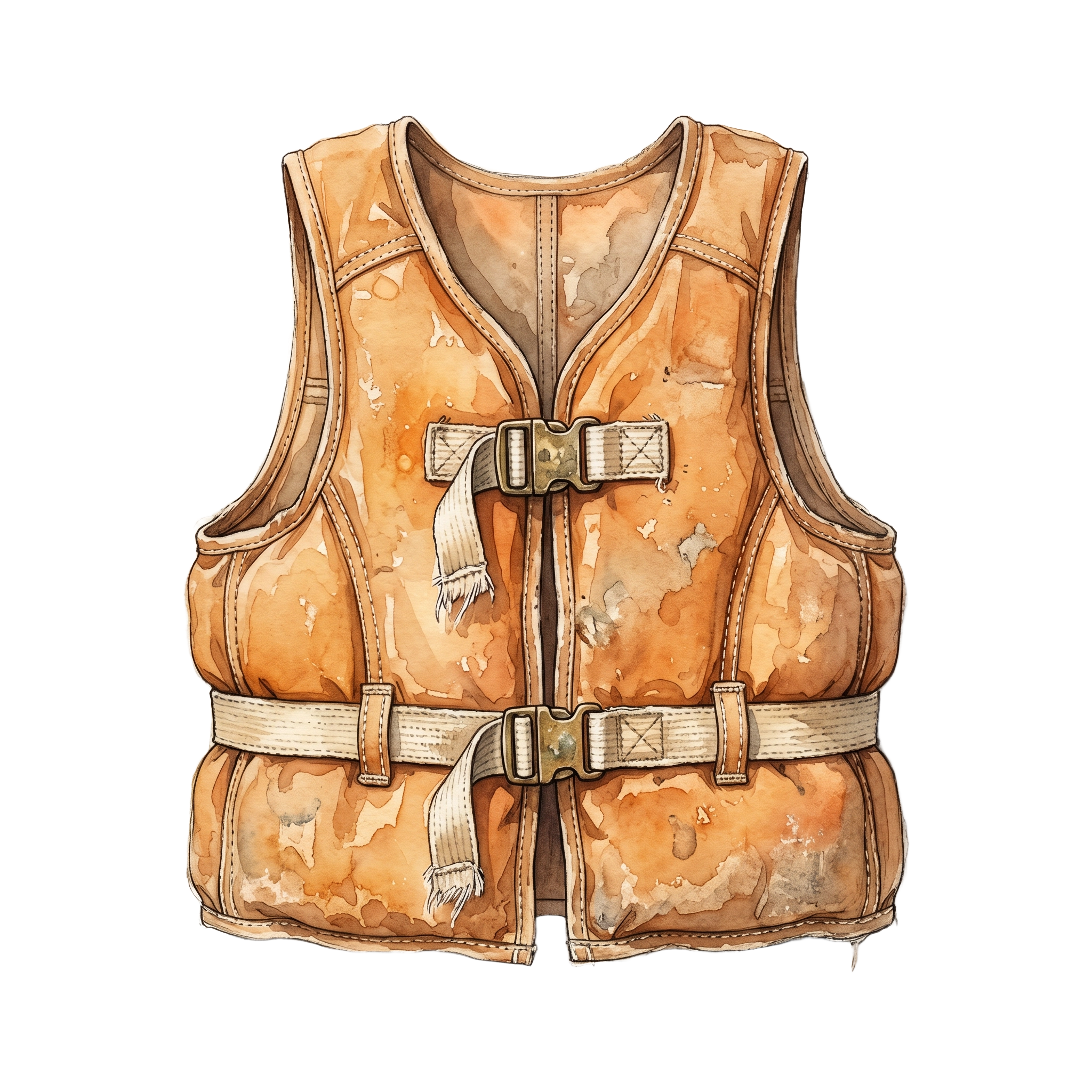
The Original Life Jacket
The original life jacket — that familiar orange canvas design — was filled with kapok. It refuses to absorb water and floats indefinitely.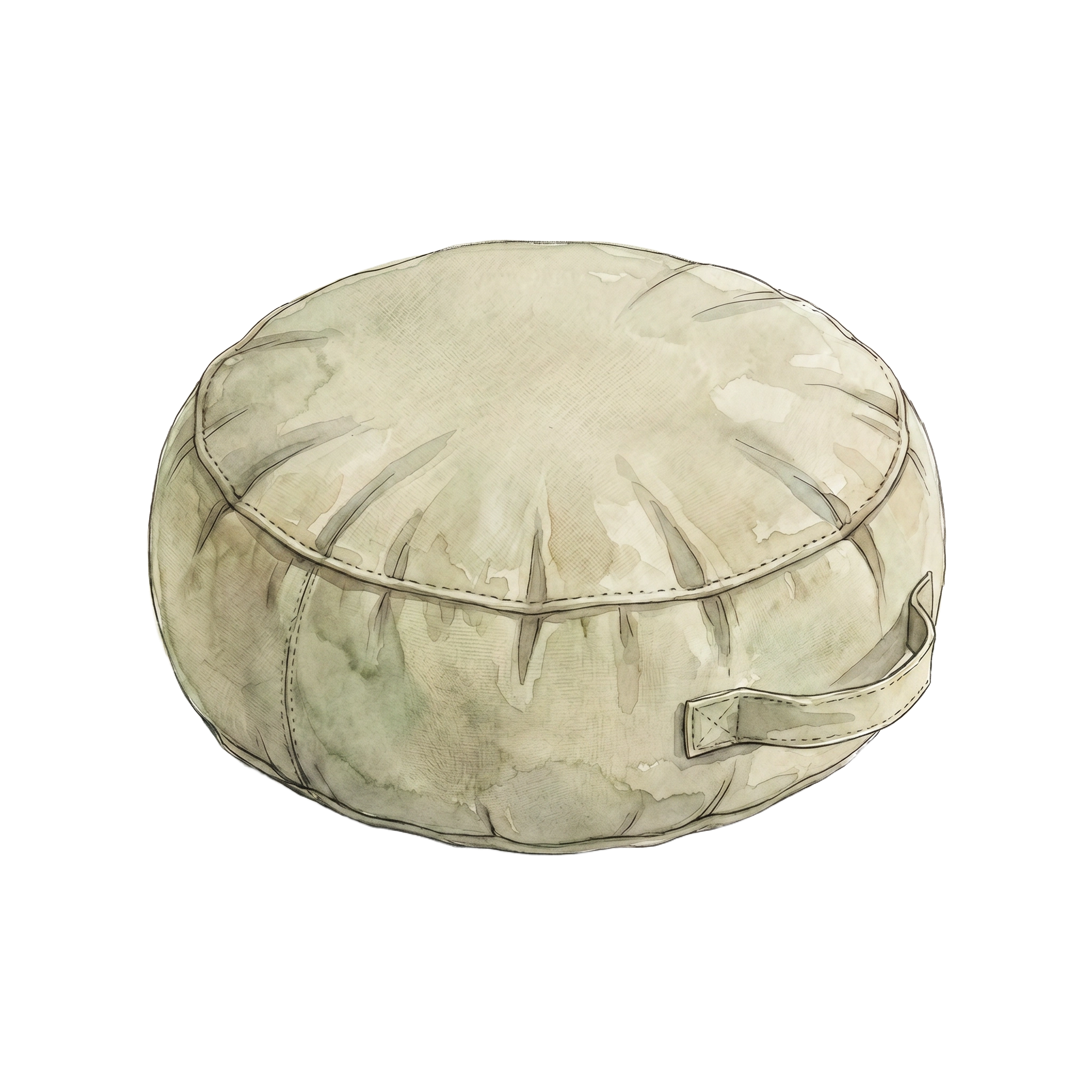
FOR GENERATIONS
Yoga & Meditation Cushions
Yoga bolsters and meditation cushions rely on kapok to hold their shape under repeated, sustained pressure for years.
PREMIUM ORGANIC
Mattresses & Pillows
Premium organic mattresses and pillows use kapok as a hypoallergenic alternative to down and synthetic foam.And now - the same material can be inside your saddle panels.
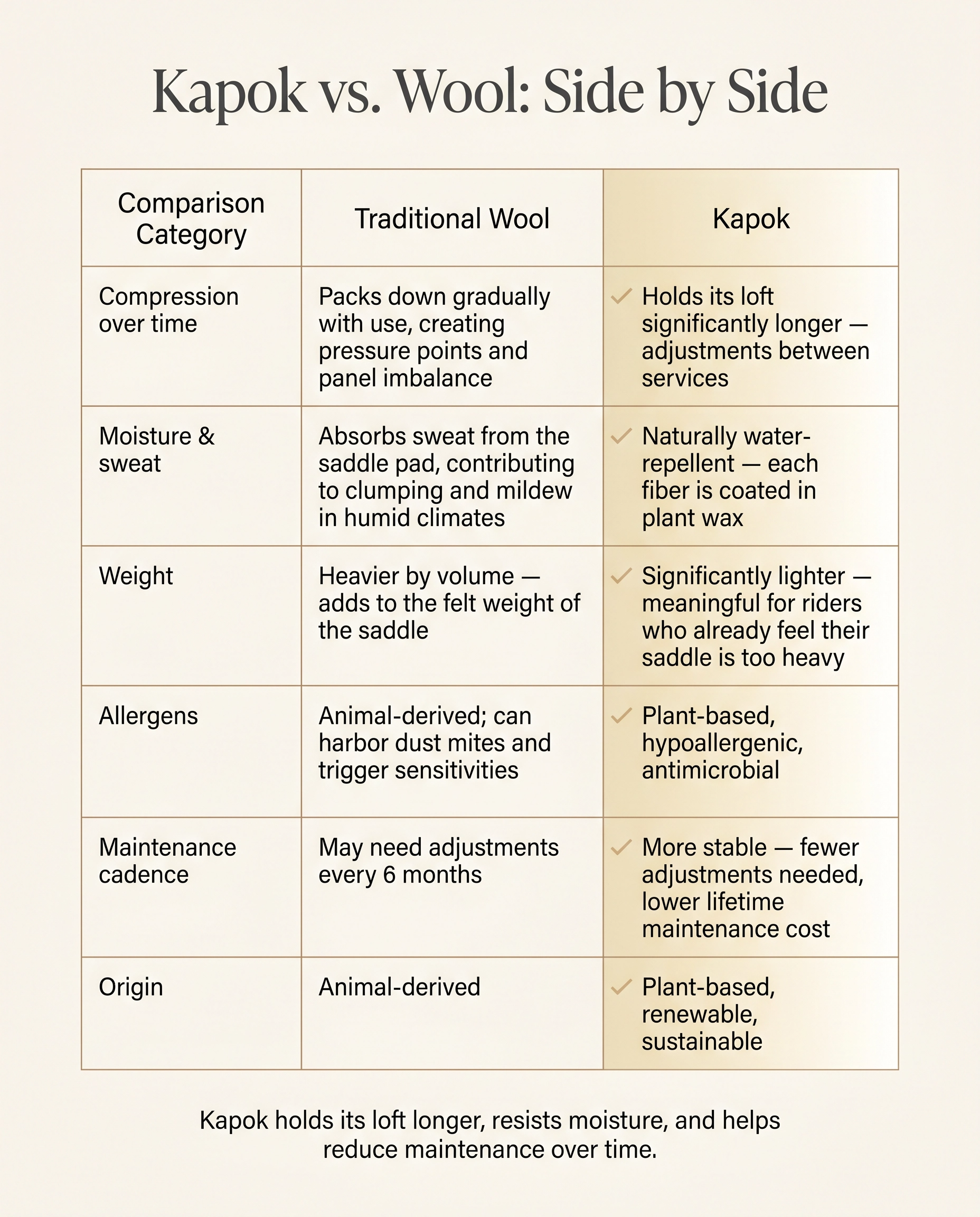
What this means for your wallet over 6 years:
A wool-flocked saddle typically needs spot adjustments every 6 months — at $75–$150 per adjustment. A kapok-flocked saddle holds its loft long enough to skip most of those.
A $100 upgrade at the strip flock can save you several hundred dollars in maintenance over the life of the saddle.
Why Riders Choose Kapok
-
1. Slow to compress.
Wool starts packing down the day it's installed. Kapok's hollow, waxed fiber structure resists compression for years — keeping your saddle balanced between fitter visits.
-
2. Lighter, reliable support.
Kapok delivers uniform, even pressure distribution across the panel surface — at a fraction of wool's weight. If your saddle already feels heavy on your horse's back, this matters.
-
3. Naturally moisture-repellent.
The natural wax coating on each fiber means kapok won't absorb sweat through the saddle pad, won't clump or become “felted”, and resists mold and mildew — even on sweaty horses, under heavy use or humid climates and barn environments.
-
4. Hypoallergenic, antimicrobial and sustainable
Plant-based. No animal proteins. No dust mite habitat. A meaningful upgrade for riders or horses with sensitivities, and for the planet.
If kapok is so good, why isn't everyone using it?
THE OBVIOUS QUESTION
Honestly? Tradition.
The saddle fitting world has used wool for generations — and when something works well enough, there's little urgency to look for something better.
Kapok isn't widely known in the industry because the industry hasn't needed to go looking for it. It isn't available through standard saddlery suppliers. Until recently, almost no saddle manufacturer offered it as a panel option at all.
Fichtbauer Saddles — by the German master saddle maker — is one of the only manufacturers in the world to offer kapok-flocked panels as standard. That's where the technique enters this workshop.
It's not a trend.
It's not a marketing angle.
It's just a better material that most of the industry hasn't caught up with yet.
THE CREDENTIAL
Why this workshop offers kapok when almost no one else in the United States does.
Trained by the Source.
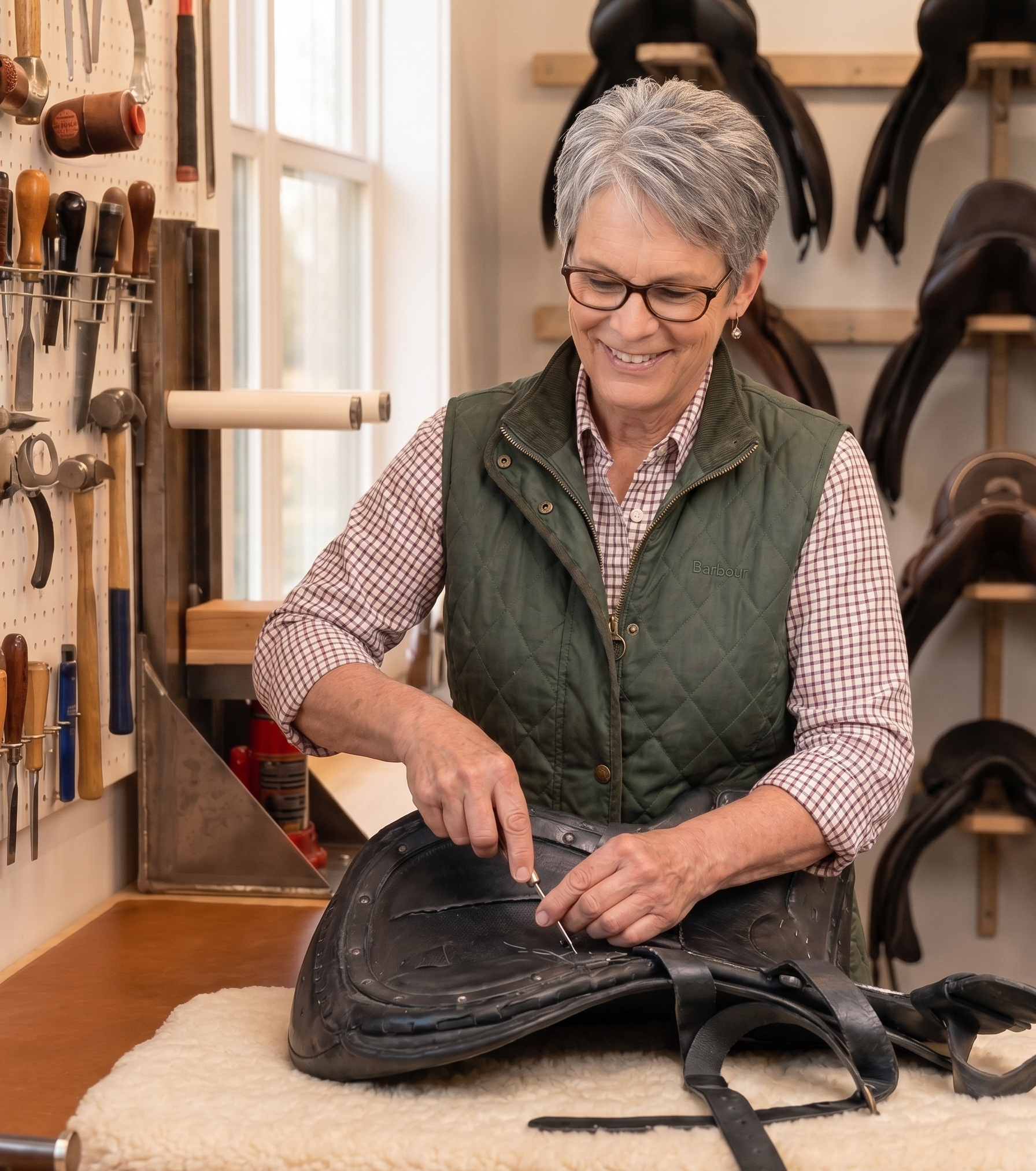
Founder of Flock My Saddle, was introduced to kapok by Thorsten Fichtbauer — the master saddler, creator, and founder of Fichtbauer Saddles, the manufacturer that pioneered kapok-flocked panels as a production standard.
Combined with her Society of Master Saddlers (UK) qualification and 30+ years working inside the panels of just about every brand of English saddles, that training makes this one of the only workshops in the United States offering kapok strip flocking as a core service.
Not as a specialty. Not on request. As standard.
Kyrena Parkinson
THE HONEST TAKE
Is Kapok the Right Choice for Your Saddle?
We won’t sell kapok service to every rider. Here’s where it fits — and where wool is still the better call.
KAPOK IS AN ESPECIALLY STRONG FIT FOR:
✓ Riders in whose horses get hot and/or sweaty when ridden
✓ Riders who want longer intervals between maintenance appointments
✓ High-mileage riders putting heavy weekly hours on the saddle
✓ Owners of saddles where weight is already a concern
✓ Anyone restoring a quality saddle they intend to keep for the long term
WOOL IS STILL RIGHT FOR:
✓ Riders whose fitter strongly prefers wool for their setup
✓ Traditionalists who want the original feel of the saddle restored exactly
✓ Saddles where panel structure or brand specification requires wool
Not sure which is right for your saddle?
THE SERVICE
Premium Kapok Strip Flock — what you get.
from $500
✓ Disassembly and reassembly of panels
✓ Tree and safety inspection
✓ Assessment of all interior panel stitching that may need repair
✓ Full panel strip and hand-formed reflocking with premium kapok fiber
✓ Deep clean and conditioning
✓ Balance assessment
✓ SMS and email updates throughout
Turnaround: 3–5 days from receipt. Rush (1–2 days) available on request.
Kapok Questions, Answered
-
Most fitters who understand the material do. We work directly with your fitter before, during, and after the restoration — they see our notes, our process, and you’ll receive a top up supply of Kapok so they can match the fiber when servicing the saddle.
If your fitter wants to speak to us first, that's a yes from us. Email kyrena@flockmysaddle.com and we'll set it up.
-
Significantly longer than wool — most riders feel the panels stay even and supportive for double the interval between flocking visits. Kapok resists compression and moisture in ways wool can't, which is why it's been used in mattresses, cushions, and life jackets for over a century.
-
Almost every wool-flocked English saddle can be rebuilt with kapok. We do a tree integrity and panel check on arrival. If we identify a structural issue that means kapok wouldn't be the right fit, we'll tell you before we begin and refund any work not yet started. Foam-paneled saddles and treeless saddles can't be reflocked.
-
Based on lifetime maintenance cost alone, yes. Wool typically needs a top-up flocking every 6 months at $75–150 per visit. Kapok stays even and supportive for 12+ months in most cases. Over the 6–10 year working life of a saddle, the kapok upgrade typically saves $300–600 in maintenance — while delivering more consistent support the whole time.
Upgrade the one part of your saddle that wears out first.
The leather lasts. The tree lasts. The panels are what fail — and what's inside the panels is what determines whether your saddle supports you for the next decade or compensates against you.
Choose the fiber that holds.
Still deciding between wool and kapok? Send Kyrena a message → and she'll talk through your saddle, your horse, and your use before you ship.